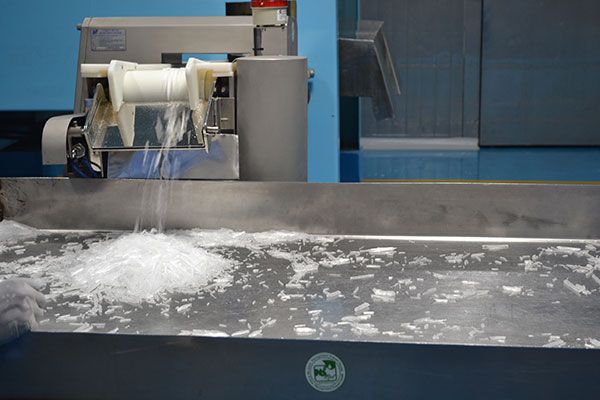

Natural menthol and synthetic menthol can look identical on a standard certificate of analysis. Both can be white crystals that pass the same pharmacopoeia monograph. The difference is where the carbon in them came from, and radiocarbon (C-14) analysis is the most direct way to measure it.
Why it matters
Cheap synthetic menthol has made undisclosed blending a real risk in the menthol and mint oil trade. A lot of “natural” menthol or cornmint oil with a share of synthetic material mixed in can still meet its specification for assay, melting point and optical rotation. If your label, your customer or your regulator says natural, you need a test that looks at origin rather than purity.
What C-14 measures
Living plants take in carbon dioxide from the air, which carries a small, steady share of the radioactive isotope carbon-14. Mint grown this season therefore contains “modern” carbon. Petrochemical feedstocks formed millions of years ago, long enough for all their carbon-14 to decay, so anything made from them contains none.
A radiocarbon laboratory measures the carbon-14 in a sample with accelerator mass spectrometry (AMS), which needs only a few milligrams. The methods are standardised in ASTM D6866 and ISO 16620-2, and the result is reported as percent modern carbon (pMC) or as a percentage of biobased carbon. Natural material reads close to 100; material made from fossil feedstocks reads 0; a blend falls in between.
Reading a C-14 certificate
The certificate below is for one lot of cornmint oil, tested by the University of Georgia’s Center for Applied Isotope Studies in the USA, a laboratory accredited to ISO/IEC 17025.
- Laboratory and certificate number. An independent lab, and a numbered certificate issued for a single lot. Ask for the lot number to match your drum labels and COA.
- pMC. The headline result. The laboratory’s own guidance is that a value between 95 and 105 pMC indicates no addition or dilution with fossil-derived carbon.
- Below 95 pMC. Indicates fossil-derived material has been added. The lot on this certificate read 82 pMC, so we rejected it.
- Above 105 pMC. Indicates carbon from other sources, such as material labelled with carbon-14 or derived from decades-old growth.
- δ13C. A stable-isotope ratio reported alongside, which gives a second view of the carbon’s origin.
What C-14 can and cannot tell you
C-14 is very good at one thing: finding carbon that came from fossil feedstocks. Several large-scale routes to synthetic menthol start from petrochemicals, for example from m-cresol or from citral built up from petrochemical building blocks, and blends with those products show up as a low pMC.
It has limits, and a good supplier will tell you so:
- Bio-based synthetics. Menthol made by chemical synthesis from plant-derived starting materials, such as terpenes, can carry modern carbon and pass a C-14 test.
- Measurement error. The standards allow an absolute error of a few percent, so very small additions may not be visible.
- Regulatory status. A 100% biobased result does not by itself prove that a flavouring meets the EU’s definition of natural under Regulation (EC) No 1334/2008, which also looks at how the material was processed.
That is why laboratories and regulators recommend combining C-14 with other evidence: stable-isotope ratios, impurity profiles, traceability back to the farm and the producer’s own guarantees.
How we use it
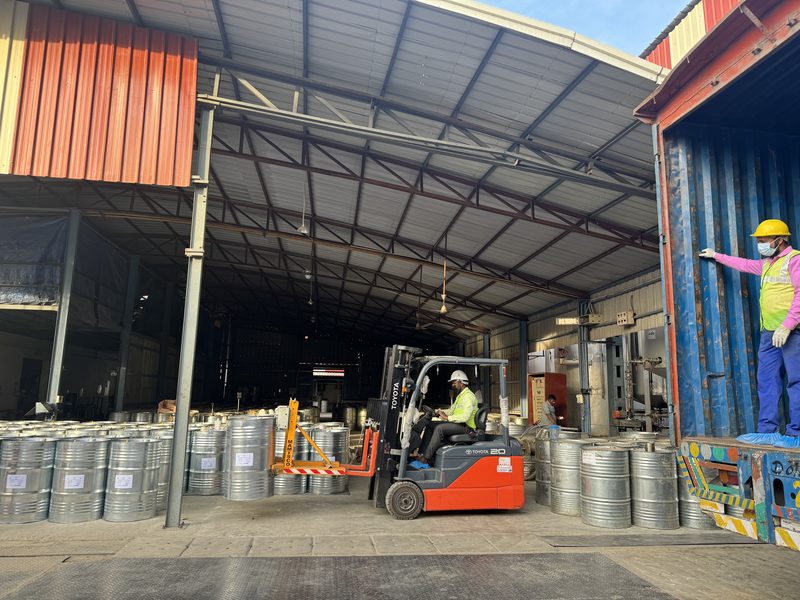
Every batch of raw material we procure undergoes C-14 radiocarbon analysis at the University of Georgia, USA, before it enters production.
- Approved: 95 to 105 pMC. The lot enters production.
- Rejected: below 95 pMC. The lot goes back to the supplier.
- Blacklisted: repeat incidents lead to supplier blacklisting.
We also buy directly through our five procurement zones, test every lot again in our own laboratories, and handle no synthetic menthol in our plant. See our quality process.
What to ask your supplier
- Is every lot of raw material C-14 tested, or only occasional samples?
- Which laboratory runs the test, and is it accredited to ISO/IEC 17025?
- Can you see the certificate for the lot you are buying, with a matching lot number?
- What pMC range does the supplier accept, and what happens to lots that fail?
- What other evidence of natural origin can they provide, such as traceability to the farm?
If you would like to see a recent C-14 certificate for the product you buy, ask our export desk. For the wider picture, read natural vs synthetic menthol.