
Selling menthol or mint oil into the European Union involves two separate sets of rules. REACH governs chemicals as substances: who must register them and what safety information travels with them. Regulation (EC) No 1334/2008 governs flavourings in food, including when a flavouring may be called natural. This guide summarises both. It is not legal advice; confirm the details for your product with your regulatory adviser.
REACH: registration
- Who registers. Every manufacturer or importer that places 1 tonne or more a year of a substance on the EU market must register it with the European Chemicals Agency (ECHA).
- Only representative. A non-EU manufacturer can appoint an EU-based only representative to register on its behalf. Importers in that supply chain are then treated as downstream users and do not need their own registration.
- Food flavouring exemption. Substances used as flavourings in food are exempt from registration for that use. Tonnage used in oral care, cosmetics, pharmaceuticals or tobacco is not covered by that exemption.
- Natural substances. Unprocessed natural substances can be exempt, but only if they are not classified as hazardous. Menthol and mint oils carry hazard classifications, so this exemption usually does not apply.
Our position: we are REACH compliant for L-menthol and peppermint oil (Mentha piperita). Ask us for the details for your volumes.
REACH: safety data sheets and labels
A safety data sheet (SDS) must accompany hazardous substances supplied in the EU, in the official language of the country of sale, using the 16 standard sections.
Typical hazard statements in supplier SDSs (self-classifications; check the SDS for your lot):
| Material | Typical hazard statements |
|---|---|
| L-menthol | H315 skin irritation, H319 eye irritation |
| Peppermint oil | H315, H317 skin sensitisation, H319, H412 or H411 aquatic toxicity (varies by supplier) |
| Cornmint oil | H302, H315, H317, H319, H411 |
L-menthol is not regulated for transport. Some mint oils are classed as environmentally hazardous (UN 3082) for sea transport, depending on the SDS.
Natural flavouring rules (Regulation (EC) No 1334/2008)
Natural flavouring substance (Article 3). A substance obtained by physical, enzymatic or microbiological processes from material of plant, animal or microbial origin, using the traditional processes listed in Annex II. These include distillation, rectification, extraction and cooling or freezing, the steps used to make natural menthol and mint oils.
Labelling (Article 16).
- “Natural X flavouring” requires at least 95% by weight of the flavouring component to come from source X. So “natural mint flavouring” must be at least 95% from mint.
- “Natural X flavouring with other natural flavourings” applies when the flavour comes partly from X but is still easily recognisable.
- “Natural flavouring” covers natural flavourings from several sources.
Pulegone and menthofuran. These mint constituents may not be added as such, and Annex III caps their levels in finished foods, for example 350 mg/kg pulegone and 1,000 mg/kg menthofuran in chewing gum. Ask for typical levels when you choose a mint oil.
Why C-14 alone is not enough for the EU
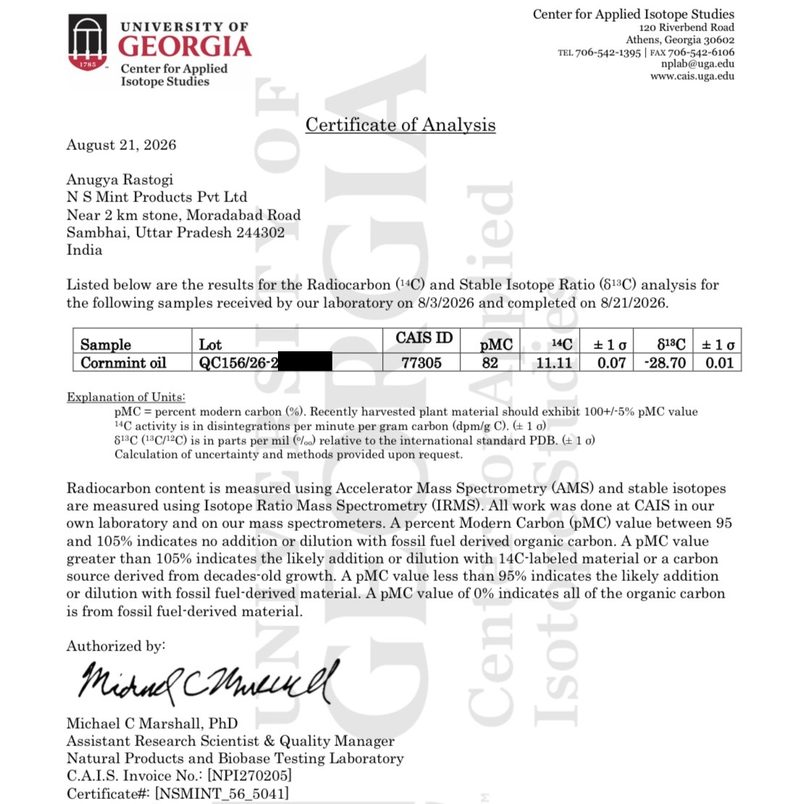
A C-14 test shows whether carbon comes from plants or from petroleum. It cannot show how a substance was made, and the EU definition depends on the process as well as the source. A synthetic made from a plant-based starting material can pass C-14 and still not be a natural flavouring. Combine C-14 with traceability and the manufacturer’s process statement. C-14 testing explained.
Documents to ask for
COA for each lot, SDS in your language, REACH registration or only-representative details, natural status statement under Regulation 1334/2008, C-14 certificate, and Halal or Kosher certificates if relevant. Documents we supply.
Sources: Regulation (EC) No 1907/2006 (REACH), Articles 2, 6, 8 and 31 and Annex V; Regulation (EC) No 1334/2008, Articles 3 and 16 and Annexes II and III (EUR-Lex); supplier safety data sheets.