
We buy Mentha arvensis oil every day through our five procurement zones in Uttar Pradesh, which gives us a close view of what is happening at the source. This is our reading of the market as of October 2026. It is a view, not a forecast you should trade on: mint oil prices move daily, and weather and speculation can change the picture quickly.
In short
- Crude Mentha arvensis oil has been in a firm upward trend since June 2026, with only a brief pause in August.
- The main driver is limited raw material at farm level: farmers are holding stock and arrivals are slow.
- DMO has risen faster than menthol, narrowing the gap between them and raising the cost of mint derivatives.
- We expect firm prices to persist until the next crop is close, around Q1 2027.
What prices have done since June
The market turned bullish around June, just as the 2026 harvest was coming in. Prices rose steadily through June and July and peaked around 20 July. They corrected slightly and held steady through August.
Momentum returned in September and early October. In the first week of October, the MCX mentha oil contract hit its 4% upper circuit. That move matched what we see on the ground rather than speculation alone.
Why: tight supply at the root
The driver has been simple. There is limited oil at the ground level. Farmers are holding their stocks tightly and releasing small lots only when prices spike, after which the market goes quiet again. Low arrivals keep the physical market tight even when futures pause.
This sits on top of a longer decline in mint area. Years of low prices have pushed many farmers towards other crops, such as maize, and published figures for Barabanki, one of the main mint districts, show output falling from about 11,200 tonnes in 2022–23 to about 7,950 tonnes in 2024–25 (WRI, June 2025).
DMO, derivatives and cis-3-hexenol
As expected, the price gap between DMO (dementholised oil) and menthol has narrowed, with DMO absorbing the larger rise. Because DMO is the starting material for many mint derivatives, this raises production costs across products such as mint terpenes and menthone.
Earlier this year, reduced DMO processing also tightened supply of cis-3-hexenol, while demand for it grew. Buyers of derivatives should expect costs to follow DMO rather than menthol.
Synthetic menthol
For several years, plentiful synthetic menthol capped price rises in natural menthol. That cap is weaker in 2026. Market reports during the year pointed to higher synthetic menthol prices in India, and commercial price trackers reported rising costs in China in Q2 2026 as m-cresol feedstock and electricity became more expensive (ChemAnalyst). Any further tightening in synthetic supply would shift more demand to natural menthol.
Tax: natural menthol now carries lower GST
Since 22 September 2025, India’s GST on natural menthol and the main goods made from it (menthol crystals, mentha oil, DTMO, DMO, spearmint oil and Mentha piperita oil) has been 5%, down from 12%. The same goods made from non-natural menthol moved to 18%. The rates are set by Notification No. 09/2025-Central Tax (Rate) of 17 September 2025, following the GST Council’s 56th meeting (GST Council). For buyers in India this improves the relative cost of natural material.
Outlook
Given the tight supply at the root, we expect the market to stay firm at least until the next crop becomes imminent, around Q1 2027. A normal harvest usually brings a seasonal softening as fresh oil arrives. A weather problem or crop damage could do the opposite.
What this means for buyers
- Plan the rest of the season now. Physical availability is constrained, and unhedged positions face supply bottlenecks and cost increases. We are helping key partners map their supply schedules to the next crop.
- Consider forward contracts. We hedge at the moment a contract is agreed, which locks in price and quantity for you. How our supply security works.
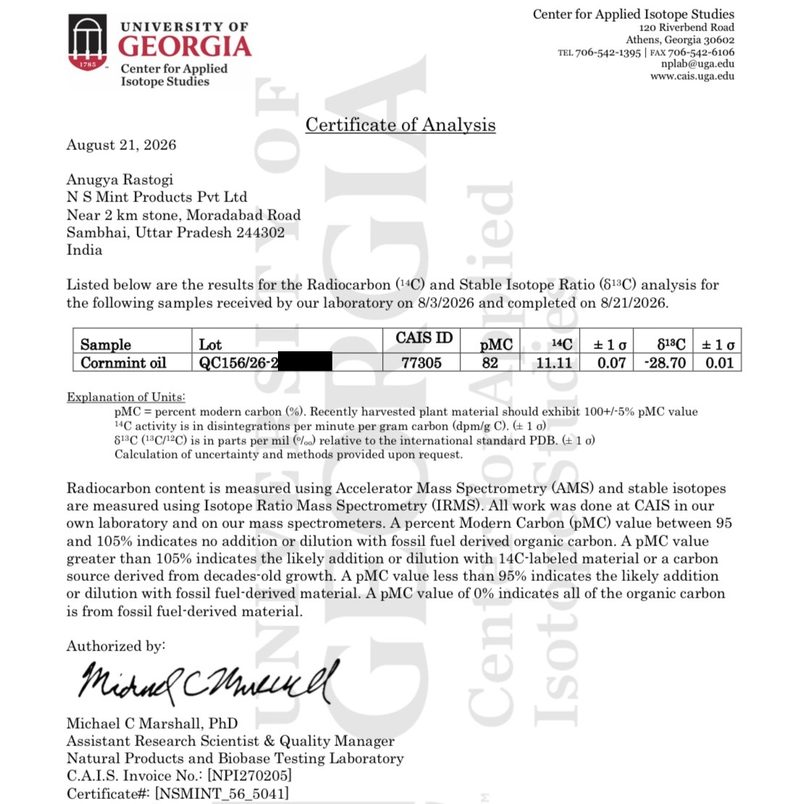
- Keep testing for origin. When natural prices rise, the temptation to blend in cheaper synthetic material rises too. Ask for a C-14 certificate for the lot you buy. C-14 testing explained.
For a quote or a supply plan for your volumes, contact our export desk.