
“Menthol” on a specification can mean two different materials. L-menthol is a single isomer, the one mint makes. DL-menthol, also called racemic menthol or racementhol, is a 50:50 mix of L-menthol and its mirror image, D-menthol. They share a chemical formula but behave differently in a product.
Eight isomers, one that matters most
Menthol has three chiral centres, so eight stereoisomers exist: menthol, neomenthol, isomenthol and neoisomenthol, each in a left- and right-handed form. In mint, almost all of the menthol is (−)-menthol, or L-menthol.
Of the eight, L-menthol gives the strongest cooling. In laboratory studies it activates TRPM8, the body’s cold receptor, at lower concentrations than the other isomers. It also has the cleanest odour: sweet and minty, where the other isomers add musty, herbal or earthy notes.
How they compare
| L-menthol | DL-menthol (racemic) | |
|---|---|---|
| CAS | 2216-51-5 | 89-78-1 |
| Composition | Single isomer, (−)-menthol | 50:50 mix of L- and D-menthol |
| Source | Natural (frozen out of mint oil) or synthetic | Synthetic |
| Melting point | 41–44 °C | About 34–36 °C; can form crystals that melt near 28 °C and 38 °C |
| Optical rotation | About −45° to −51° | About 0° |
| Cooling | Strongest | Weaker per gram, because half is the less active D-form |
| Odour | Clean, sweet, minty | Can carry off-notes from other isomers |
How racemic menthol is made
DL-menthol is made by synthesis. A common route hydrogenates thymol to a mixture of menthol isomers, separates DL-menthol by distillation, and recycles the rest. Some producers then resolve the racemate to obtain L-menthol. There is no natural source of DL-menthol.
On the specification and the COA
- European Pharmacopoeia has separate monographs: Levomenthol for L-menthol and Racementhol for DL-menthol.
- Japanese Pharmacopoeia has l-Menthol and dl-Menthol.
- USP has one Menthol monograph that covers both, but the label must state whether the material is levorotatory or racemic.
The quickest check is specific optical rotation on the COA: about −48° to −51° for L-menthol, close to zero for DL-menthol. How to read a menthol COA.
Which should you use?
Formulators choose L-menthol when cooling strength per gram, a clean mint odour, or a “natural” claim matter, as in oral care, confectionery, chewing gum and fine pharmaceutical grades. DL-menthol is used where cost matters more than odour and the label does not need to say natural.
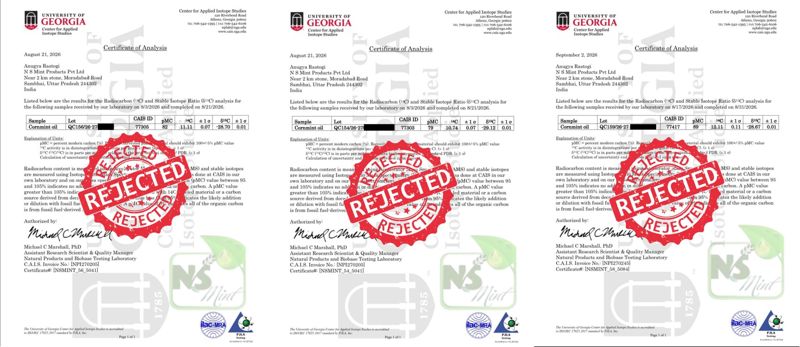
Only L-menthol can be natural. If your label says natural menthol, specify L-menthol from mint and ask for proof of origin. C-14 testing explained.
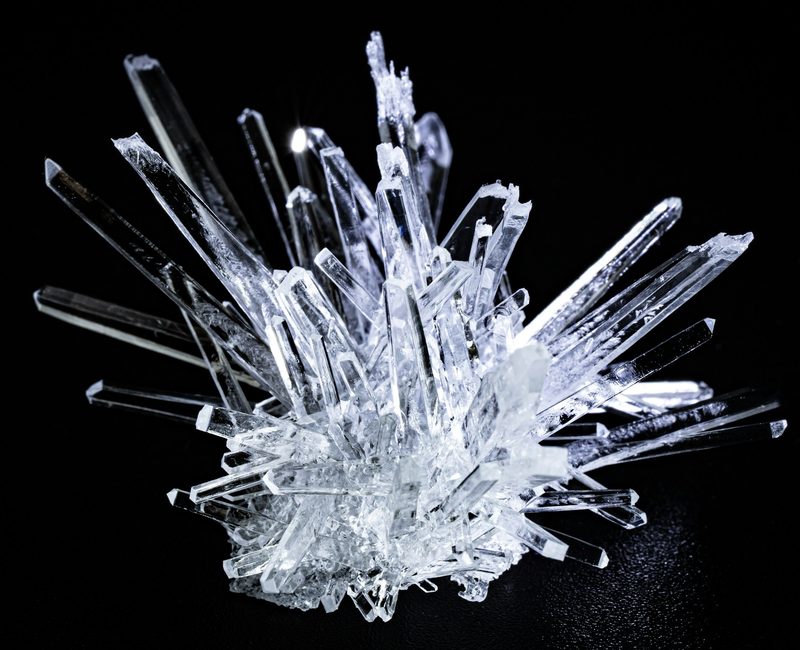
All our menthol is natural L-menthol, crystallised from Indian Mentha arvensis oil. See L-Menthol Crystals.